2026-05-19
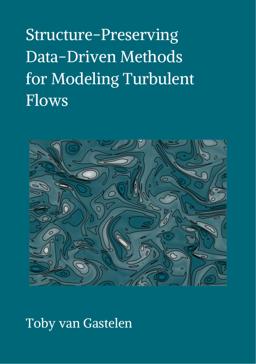
Structure-preserving data-driven methods for modeling turbulent flows
Publication
Publication
In this thesis, we present novel data-driven approaches for efficient simulation of fluid flows. The ideas are mainly applied to the incompressible Navier-Stokes equations, but also to Burgers' equation, Korteweg-de Vries equation, and the linear advection equation. For the first three equations, we mainly stick to the large eddy simulation (LES) framework. In the LES framework, the small-scale fluctuations of the turbulent flow are discarded using a spatial filter. The filtering leads to an unclosed system of equations, including a closure term that still depends on the discarded small scales. From our inability to compute this term exactly during simulation time arises the need for modeling. During modeling, the closure term is approximated by a closure model, which solely depends on large-scale quantities. This closure model is then tasked with accounting for the effect of these small scales on the large scales. In our work, we often take the `discretize first, filter next' approach. The advantage of first discretizing the equations is that this not only accounts for the absence of the small-scale fluctuations, but also for the spatial discretization error. Following recent trends, we leverage the power of machine learning algorithms, and particularly convolutional neural networks (CNNs), to learn such closure models from high-fidelity simulations. After training the machine learning models, this results in a significant reduction of simulation time. However, even when large amounts of data are used to train the machine learning models, stability is not guaranteed. This is because these models do not inherently abide by certain physical structure of the fluid flow equations, such as energy conservation. The result is that physics-agnostic machine learning-based closure models often cause instabilities during the simulation. In this thesis, we aim to resolve these instabilities. To achieve stable and physics-aware closure models, we take inspiration from classical numerical discretization techniques to build this structure directly into the machine learning models. The results is a specialized formulation for the closure model, based on existing data-driven algorithms. Besides CNNs, we also consider linear models in the evolve-filter-relax (EFR) framework, which is closely related to LES.In addition to LES, we also consider reduced-order models (ROMs). These are related to LES in the fact that both reduce the dimension of the problem. However, in ROMs this dimension reduction is not achieved using a physical filter, but using data-driven approaches to obtain a reduced basis. This is typically done by carrying out a singular value decomposition (SVD) on simulation data. However, the resulting reduced basis is notoriously bad at representing turbulent flows. In this thesis, we suggest a new way to obtain this basis, which is more suitable for representing turbulent flows. The core contributions are presented in the four main chapters of the thesis:In Chapter 2, we consider Burgers' equation and Korteweg-de Vries equation (in 1D). A spatial averaging filter is introduced and applied to a high resolution discretization. We show that the turbulent fluctuations, removed by the filter, can be compressed and their energy reintroduced into the system. This leads to a new energy conservation law. A structure-preserving neural network architecture is introduced, which satisfies this law. This results in improved stability and accuracy for the resulting LES, as opposed to standard CNNs.In Chapter 3, we consider the incompressible Navier-Stokes equations in 2D. We build upon the work in Chapter 2 by applying the same neural network architecture in 2D, but without the compressed turbulent representation, as their representation for multiple dimensions is still an open problem. The result is a strictly dissipative closure model. We show that the model outperforms standard CNNs, as well as existing eddy-viscosity models, while producing stable simulations. For long-time simulations, the benefits become especially clear when looking at statistical quantities such as energy spectra In Chapter 4, we take another perspective on LES by working in the EFR framework. This framework serves a similar purpose as LES, but has the advantage of being easier to integrate into existing codes. Our contribution consists of proposing a new data-driven filter, efficiently applied in Fourier space, which replaces the differential filter commonly used in the EFR framework. The data-driven filter is optimized efficiently by solving a simple least-squares optimization problem. This circumvents the need for computationally expensive neural network training. Using limited training data, the filter is capable of outperforming existing approaches. In the sparse data regime, applying physical constraints, such as energy and enstrophy conservation, offers further stability and accuracy benefits. In the last chapter, we step away from LES and consider projection-based ROMs. In particular, we address the limited capability of the proper orthogonal decomposition (POD) basis to represent advection-dominated flows (such as turbulent flows). As a solution for this, we propose a space-local POD basis. Furthermore, we introduce a space-local POD basis with overlapping subdomains, which draws inspiration from a finite element basis to obtain a smooth reconstruction. We show that both space-local approaches result in a basis that generalizes better for advection-dominated problems. Due to the local support of the space-local bases the resulting ROMs not only generalize better, but are also more computationally efficient than standard POD Galerkin ROMs. This thesis offers novel insights in the benefits of building physical structure into data-driven methods for fluid simulations. The introduced approaches serve as an important building block to bringing structure-preserving data-driven approaches to simulating real-life flow scenarios.
| Additional Metadata | |
|---|---|
| B. Sanderse (Benjamin) | |
| W.N. Edeling (Wouter) | |
| Eindhoven University of Technology | |
| Organisation | Scientific Computing |
|
van Gastelen, T. (2026). Structure-preserving data-driven methods for modeling turbulent flows. |
|