2026-01-14
Understanding trust toward human versus AI-generated health information through behavioral and physiological sensing
Publication
Publication
International Journal of Human-Computer Studies , Volume 209 p. 103714:1- 103714:25
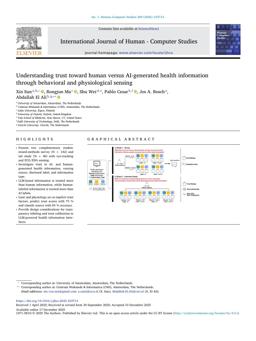
As AI-generated health information proliferates online and becomes increasingly indistinguishable from human-sourced information, it becomes critical to understand how people trust and label such content, especially when the information is inaccurate. We conducted two complementary studies: (1) a mixed-methods survey (N=142) employing a 2 (source: Human vs. LLM) × 2 (label: Human vs. AI) × 3 (type: General, Symptom, Treatment) design, and (2) a within-subjects lab study (N=40) incorporating eye-tracking and physiological sensing (ECG, EDA, skin temperature). Participants were presented with health information varying by source-label combinations and asked to rate their trust, while their gaze behavior and physiological signals were recorded. We found that LLM-generated information was trusted more than human-generated content, whereas information labeled as human was trusted more than that labeled as AI. Trust remained consistent across information types. Eye-tracking and physiological responses varied significantly by source and label. Machine learning models trained on these behavioral and physiological features predicted binary self-reported trust levels with 73 % accuracy and information source with 65 % accuracy. Our findings demonstrate that adding transparency labels to online health information modulates trust. Behavioral and physiological features show potential to verify trust perceptions and indicate if additional transparency is needed.
| Additional Metadata | |
|---|---|
| , , , , , | |
| doi.org/10.1016/j.ijhcs.2025.103714 | |
| International Journal of Human-Computer Studies | |
| creativecommons.org/licenses/by/4.0/ | |
| Organisation | Centrum Wiskunde & Informatica, Amsterdam (CWI), The Netherlands |
|
Sun, X., Ma, R., Wei, S., César Garcia, P. S., Bosch, J.& El Ali, A. (2026). Understanding trust toward human versus AI-generated health information through behavioral and physiological sensing. International Journal of Human-Computer Studies, 209, 103714:1–103714:25.https://doi.org/10.1016/j.ijhcs.2025.103714 |
|