2025-09-11
Minimizers in semi-dynamic strings
Publication
Publication
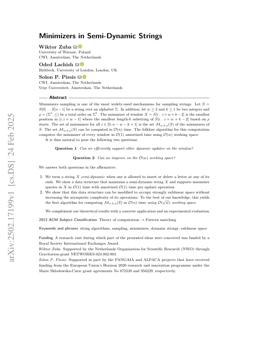
Minimizers sampling is one of the most widely-used mechanisms for sampling strings. Let $S=S[0]\ldots S[n-1]$ be a string over an alphabet $\Sigma$. In addition, let $w\geq 2$ and $k\geq 1$ be two integers and $\rho=(\Sigma^k,\leq)$ be a total order on $\Sigma^k$. The minimizer of window $X=S[i\mathinner{.\,.} i+w+k-2]$ is the smallest position in $[i,i+w-1]$ where the smallest length-$k$ substring of $S[i\mathinner{.\,.} i+w+k-2]$ based on $\rho$ starts. The set of minimizers for all $i\in[0,n-w-k+1]$ is the set $\mathcal{M}_{w,k,\rho}(S)$ of the minimizers of $S$. The set $\mathcal{M}_{w,k,\rho}(S)$ can be computed in $\mathcal{O}(n)$ time. The folklore algorithm for this computation computes the minimizer of every window in $\mathcal{O}(1)$ amortized time using $\mathcal{O}(w)$ working space. It is thus natural to pose the following two questions: Question 1: Can we efficiently support other dynamic updates on the window? Question 2: Can we improve on the $\mathcal{O}(w)$ working space? We answer both questions in the affirmative: 1. We term a string $X$ semi-dynamic when one is allowed to insert or delete a letter at any of its ends. We show a data structure that maintains a semi-dynamic string $X$ and supports minimizer queries in $X$ in $\mathcal{O}(1)$ time with amortized $\mathcal{O}(1)$ time per update operation. 2. We show that this data structure can be modified to occupy strongly sublinear space without increasing the asymptotic complexity of its operations. To the best of our knowledge, this yields the first algorithm for computing $\mathcal{M}_{w,k,\rho}(S)$ in $\mathcal{O}(n)$ time using $\mathcal{O}(\sqrt{w})$ working space. We complement our theoretical results with a concrete application and an experimental evaluation.
| Additional Metadata | |
|---|---|
| , , , , | |
| doi.org/10.1007/978-3-032-04700-7_32 | |
| Networks , Pan-genome Graph Algorithms and Data Integration , Algorithms for PAngenome Computational Analysis | |
| International Symposium on Fundamentals of Computation Theory (FCT 2025) | |
| , , | |
| Organisation | Networks and Optimization |
|
Zuba, W., Lachish, O.& Pissis, S. (2025). Minimizers in semi-dynamic strings. Proceedings of Fundamentals of Computation Theory, 434–447.https://doi.org/10.1007/978-3-032-04700-7_32 |
|