2025-11-24
Random regular graph states are complex at almost any depth
Publication
Publication
PRX Quantum , Volume 6 p. 040344:1- 040344:40
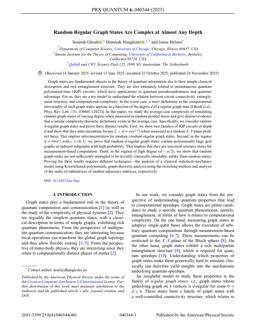
Graph states are fundamental objects in the theory of quantum information due to their simple classical description and rich entanglement structure. They are also intimately related to instantaneous quantum polynomial-time (IQP) circuits, which have applications in quantum pseudorandomness and quantum advantage. For us, they are a toy model to understand the relation between circuit connectivity, entanglement structure, and computational complexity. In the worst case, a strict dichotomy in the computational universality of such graph states appears as a function of the degree of a regular graph state [Ghosh et al., Phys. Rev. Lett. 131, 030601 (2023)]. In this paper, we study the average-case complexity of simulating random graph states of varying degree when measured in random product bases and give distinct evidence that a similar complexity-theoretic dichotomy exists in the average case. Specifically, we consider random $d$-regular graph states and prove three distinct results: First, we show two families of IQP circuits of depth $d$ and show that they anticoncentrate for any $2 < d=o(n^{1/2})$ when measured in a random $X-Y$ plane product basis. This implies anticoncentration for random constant-regular graph states. Second, in the regime $d =\Theta(n^c)$ with $c \in (0,1)$, we prove that random $d$-regular graph states contain polynomially large grid graphs as induced subgraphs with high probability. This implies that they are universal resource states for measurement-based computation. Third, in the regime of high degree $(d ∼n/2)$, we show that random graph states are not sufficiently entangled to be trivially classically simulable, unlike Haar-random states. Proving the three results requires different techniques—the analysis of a classical statistical-mechanics model using Krawtchouck polynomials, graph-theoretic analysis using the switching method, and analysis of the ranks of submatrices of random adjacency matrices, respectively.
| Additional Metadata | |
|---|---|
| doi.org/10.1103/52xz-3hpc | |
| PRX Quantum | |
| Zwaartekracht QSC Ada Lovelace | |
| creativecommons.org/licenses/by/4.0/ | |
| Organisation | Algorithms and Complexity |
|
Ghosh, S., Hangleiter, D.& Helsen, J. (2025). Random regular graph states are complex at almost any depth. PRX Quantum, 6, 040344:1–040344:40.https://doi.org/10.1103/52xz-3hpc |
|