2025-12-15
Predicting the outcome of ongoing automated negotiations
Publication
Publication
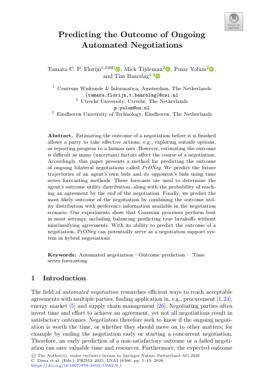
Estimating the outcome of a negotiation before it is finished allows a party to take effective actions, e.g., exploring outside options, or reporting progress to a human user. However, estimating the outcome is difficult as many (uncertain) factors affect the course of a negotiation. Accordingly, this paper presents a method for predicting the outcome of ongoing bilateral negotiations called PrONeg. We predict the future trajectories of an agent’s own bids and its opponent’s bids using time series forecasting methods. These forecasts are used to determine the agent’s outcome utility distribution, along with the probability of reaching an agreement by the end of the negotiation. Finally, we predict the most likely outcome of the negotiation by combining the outcome utility distribution with preference information available in the negotiation scenario. Our experiments show that Gaussian processes perform best in most settings, including balancing predicting true breakoffs without misclassifying agreements. With its ability to predict the outcome of a negotiation, PrONeg can potentially serve as a negotiation support system in hybrid negotiations.
| Additional Metadata | |
|---|---|
| doi.org/10.1007/978-3-032-13562-9_1 | |
| Lecture Notes in Computer Science/Lecture Notes in Artificial Intelligence | |
| Coordinating Multi-deal Bilateral Negotiations | |
| 26th International Conference on Principles and Practice of Multi-Agent Systems (PRIMA 2025) | |
| Organisation | Intelligent and autonomous systems |
|
Florijn, T., Tijdeman, M., Yolum, P.& Baarslag, T. (2025, December 15). Predicting the outcome of ongoing automated negotiations. PRIMA: Principles and Practice of Multi-Agent Systems, 16366.https://doi.org/10.1007/978-3-032-13562-9_1 |
|