2025-06-15
Single-copy stabilizer testing
Publication
Publication
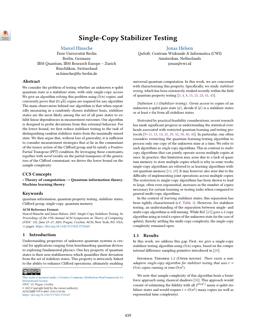
We consider the problem of testing whether an unknown n-qubit quantum state is a stabilizer state, with only single-copy access. We give an algorithm solving this problem using $O(n)$ copies, and conversely prove that $ω(√n)$ copies are required for any algorithm. The main observation behind our algorithm is that when repeatedly measuring in a randomly chosen stabilizer basis, stabilizer states are the most likely among the set of all pure states to exhibit linear dependencies in measurement outcomes. Our algorithm is designed to probe deviations from this extremal behavior. For the lower bound, we first reduce stabilizer testing to the task of distinguishing random stabilizer states from the maximally mixed state. We then argue that, without loss of generality, it is sufficient to consider measurement strategies that a) lie in the commutant of the tensor action of the Clifford group and b) satisfy a Positive Partial Transpose (PPT) condition. By leveraging these constraints, together with novel results on the partial transposes of the generators of the Clifford commutant, we derive the lower bound on the sample complexity.
| Additional Metadata | |
|---|---|
| , , , , , | |
| doi.org/10.1145/3717823.3718169 | |
| Randomness in quantum computation , Zwaartekracht QSC Ada Lovelace | |
| 57th Annual ACM Symposium on Theory of Computing, STOC 2025 | |
|
Hinsche, M.& Helsen, J. (2025). Single-copy stabilizer testing. Proceedings of the Annual ACM Symposium on Theory of Computing, 439–450.https://doi.org/10.1145/3717823.3718169 |
|