2025-10-03
Structural similarity in joint inverse problems
Publication
Publication
Acta Applicandae Mathematicae , Volume 199 p. 11:1- 11:20
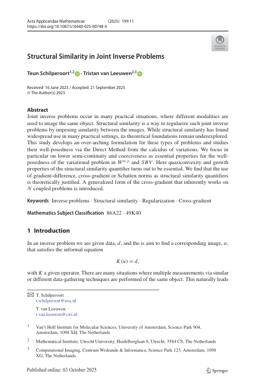
Joint inverse problems occur in many practical situations, where different modalities are used to image the same object. Structural similarity is a way to regularize such joint inverse problems by imposing similarity between the images. While structural similarity has found widespread use in many practical settings, its theoretical foundations remain underexplored. This study develops an over-arching formulation for these types of problems and studies their well-posedness via the Direct Method from the calculus of variations. We focus in particular on lower semi-continuity and coerciveness as essential properties for the wellposedness of the variational problem in $W^{m,p}$ and $SBV$. Here quasiconvexity and growth properties of the structural similarity quantifier turns out to be essential. We find that the use of gradient-difference, cross-gradient or Schatten norms as structural similarity quantifiers is theoretically justified. A generalized form of the cross-gradient that inherently works on $N$ coupled problems is introduced.
| Additional Metadata | |
|---|---|
| , , , | |
| , | |
| doi.org/10.1007/s10440-025-00748-4 | |
| Acta Applicandae Mathematicae | |
| Organisation | Computational Imaging |
|
Schilperoort, T.& van Leeuwen, T. (2025). Structural similarity in joint inverse problems. Acta Applicandae Mathematicae, 199, 11:1–11:20.https://doi.org/10.1007/s10440-025-00748-4 |
|