2026-10-04
Towards gaze-informed AI disclosure interfaces: Eye-tracking attentional and cognitive load while reading AI-assisted news
Publication
Publication
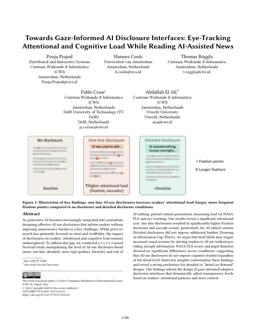
As generative AI becomes increasingly integrated into journalism, designing effective AI-use disclosures that inform readers without imposing unnecessary burden is a key challenge. While prior research has primarily focused on trust and credibility, the impact of disclosures on readers' attentional and cognitive load remains underexplored. To address this gap, we conducted a 3 × 2 × 2 mixed factorial study manipulating the level of AI-use disclosure detail (none, one-line, detailed), news type (politics, lifestyle), and role of AI (editing, partial content generation), measuring load via NASA-TLX and eye-tracking. Our results reveal a significant attentional cost: one-line disclosures resulted in significantly higher fixation durations and saccade counts, particularly for AI-edited content. Detailed disclosures did not impose additional burden. Drawing on Information-Gap Theory, we argue that brief labels may trigger increased visual scrutiny by alerting readers to AI use without providing enough information. NASA-TLX scores and pupil diameter showed no significant differences across conditions, suggesting that AI-use disclosures do not impose cognitive burden regardless of the detail level. Interview insights contextualize these findings and reveal a strong preference for detailed or "detail-on-demand" designs. Our findings inform the design of gaze-informed adaptive disclosure interfaces that dynamically adjust transparency levels based on readers’ attentional patterns and news context.
| Additional Metadata | |
|---|---|
| , , , , , , , | |
| doi.org/10.1145/3776574.3831231 | |
| AI, Media & Democracy Lab | |
| ICMI '26: International Conference on Multimodal Interaction | |
| creativecommons.org/licenses/by/4.0/ | |
| Organisation | Distributed and Interactive Systems |
|
Prajod, P., Cools, H., Röggla, T., César Garcia, P. S.& El Ali, A. (2026). Towards gaze-informed AI disclosure interfaces: Eye-tracking attentional and cognitive load while reading AI-assisted news. Proceedings of the 28th International Conference On Multimodal Interaction, 1188–1197.https://doi.org/10.1145/3776574.3831231 |
|