2026-06-09
Trust region interior point methods: Optimal $\ell_2$- and faster wide-neighborhood path following
Publication
Publication
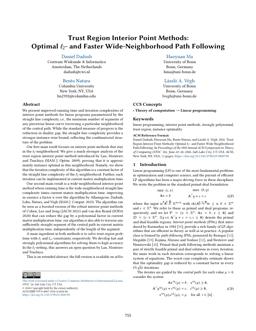
We present improved running time and iteration complexities of interior point methods for linear programs parametrized by the straight line complexity, i.e., the minimum number of segments of any piecewise linear curve traversing a particular neighborhood of the central path. While the standard measure of progress is the reduction in duality gap, the straight line complexity provides a stronger instance-wise bound, reflecting the combinatorial structure of the problem. Our first main result is a wide-neighborhood interior point method whose running time is the wide-neighborhood straight line complexity times current matrix multiplication time, improving in essence a factor $n$ over the algorithm by Allamigeon, Dadush, Loho, Natura, and Végh (SIAM J. Comput. 2025). The algorithm can be seen as a boosted version of the robust interior point methods of Cohen, Lee and Song (JACM 2021) and van den Brand (SODA 2020) that can reduce the gap by a polynomial factor in current matrix multiplication time. Our algorithm is also able to traverse any near-linear segments of the central path in current matrix multiplication time, independently of the length of the segment. Our second main result focuses on interior point methods that stay in the narrow $\ell_2$-neighborhood. We give a much stronger analysis of the $\ell_2$-trust region interior point method introduced by Lan, Monteiro and Tsuchiya (SIAM J. Optim. 2009), showing that it is approximately instance optimal in this neighborhood: the number of iterations is within a constant factor of the lower bound. A main ingredient in both methods are trust region subroutines with $\ell_∞$ and $\ell_2$-constraints, respectively. We develop fast and strongly polynomial algorithms for solving both these problems to high accuracy. In the $\ell_2$-setting, this answers an open question by Lan, Monteiro and Tsuchiya.
| Additional Metadata | |
|---|---|
| , , , , | |
| doi.org/10.1145/3798129.3800790 | |
| STOC '26: 58th Annual ACM Symposium on Theory of Computing | |
| creativecommons.org/licenses/by/4.0 | |
| Organisation | Centrum Wiskunde & Informatica, Amsterdam (CWI), The Netherlands |
|
Dadush, D., Ma, H., Natura, B.& Végh, L. (2026). Trust region interior point methods: Optimal $\ell_2$- and faster wide-neighborhood path following. Proceedings of the Annual ACM Symposium on Theory of Computing, 755–766.https://doi.org/10.1145/3798129.3800790 |
|