2026-04-08
WebRTC-based volumetric video conferencing: SFU architecture evaluation and benchmarking
Publication
Publication
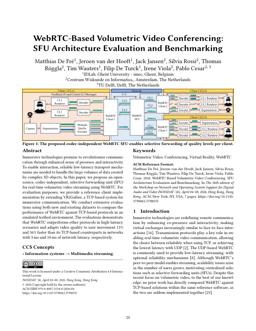
Immersive technologies promise to revolutionize communication through enhanced sense of presence and interactivity. To enable interaction, reliable low-latency transport mechanisms are needed to handle the large volumes of data created by complex 3D objects. In this paper, we propose an open-source, codec-independent, selective forwarding unit (SFU) for real-time volumetric video streaming using WebRTC. For evaluation purposes, we provide a reference client implementation by extending VR2Gather, a TCP-based system for immersive communication. We conduct extensive evaluations using both new and existing datasets to compare the performance of WebRTC against TCP-based protocols in an emulated testbed environment. The evaluations demonstrate that WebRTC outperforms other protocols in high-latency scenarios and adapts video quality to user movement 13% and 36% faster than its TCP-based counterparts in networks with 5 ms and 10 ms of network latency, respectively.
| Additional Metadata | |
|---|---|
| , , , | |
| Association for Computing Machinery | |
| doi.org/10.1145/3798065.3798070 | |
| Scalable platform for innovations on real-time immersive telepresence , INDUX-R , Ignite the Immersive Media Sector by Enabling New Narrative Visions | |
| NOSSDAV '26: ACM Multimedia Systems Conference | |
| creativecommons.org/licenses/by/4.0/ | |
| , , | |
| Organisation | Distributed and Interactive Systems |
|
De Fré, M., Van der Hooft, J., Jansen, J., Rossi, S., Röggla, T., Wauters, T., De Turck, F., Viola, I.& César Garcia, P. S. (2026). WebRTC-based volumetric video conferencing: SFU architecture evaluation and benchmarking. Proceedings of the Workshop on Network and Operating System Support for Digital Audio and Video, 29–35.https://doi.org/10.1145/3798065.3798070 |
|