
2026-04-13
More human or more AI? Visualizing human-AI collaboration disclosures in journalistic news production
Publication
Publication
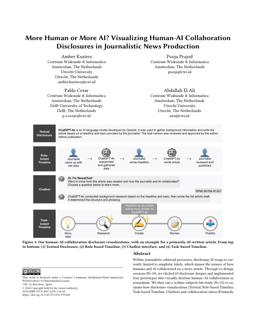
Within journalistic editorial processes, disclosing AI usage is currently limited to simplistic labels, which misses the nuance of how humans and AI collaborated on a news article. Through co-design sessions (N=10), we elicited 69 disclosure designs and implemented four prototypes that visually disclose human–AI collaboration in journalism. We then ran a within-subjects lab study (N=32) to examine how disclosure visualizations (Textual, Role-based Timeline, Task-based Timeline, Chatbot) and collaboration ratios (Primarily Human vs. Primarily AI) influenced visualization perceptions, gaze patterns, and post-experience responses. We found that textual disclosures were least effective in communicating human-AI collaboration, whereas Chatbot offered the most in-depth information. Furthermore, while role-based timelines amplified AI contribution in primarily human articles, task-based timeline shifted perceptions toward human involvement in primarily AI articles. We contribute Human-AI collaboration disclosure visualizations and their evaluation, and cautionary considerations on how visualizations can alter perceptions of AI’s actual role during news article creation.
| Additional Metadata | |
|---|---|
| , , , , | |
| Association for Computing Machinery | |
| doi.org/10.1145/3772318.3791288 | |
| CHI 2026: CHI Conference on Human Factors in Computing Systems | |
| creativecommons.org/licenses/by-nc-nd/4.0/ | |
| Organisation | Distributed and Interactive Systems |
|
Kusters, A., Prajod, P., César Garcia, P. S.& El Ali, A. (2026). More human or more AI? Visualizing human-AI collaboration disclosures in journalistic news production. Proceedings of the Conference on Human Factors in Computing Systems, 729:1–729:22.https://doi.org/10.1145/3772318.3791288 |
|
| See Also |
|---|