2026-06-01
From models to mobility systems: A survey of multimodal dynamic traffic assignment
Publication
Publication
Operations Research Forum , Volume 7 - Issue 2 p. 58:1- 58:37
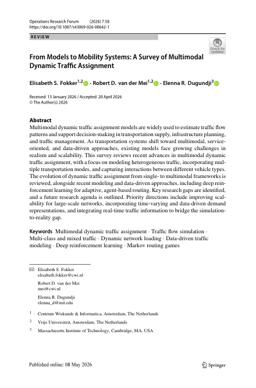
Multimodal dynamic traffic assignment models are widely used to estimate traffic flow patterns and support decision-making in transportation supply, infrastructure planning, and traffic management. As transportation systems shift toward multimodal, service-oriented, and data-driven approaches, existing models face growing challenges in realism and scalability. This survey reviews recent advances in multimodal dynamic traffic assignment, with a focus on modeling heterogeneous traffic, incorporating multiple transportation modes, and capturing interactions between different vehicle types. The evolution of dynamic traffic assignment from single- to multimodal frameworks is reviewed, alongside recent modeling and data-driven approaches, including deep reinforcement learning for adaptive, agent-based routing. Key research gaps are identified, and a future research agenda is outlined. Priority directions include improving scalability for large-scale networks, incorporating time-varying and data-driven demand representations, and integrating real-time traffic information to bridge the simulation-to-reality gap.
| Additional Metadata | |
|---|---|
| , , , , , , | |
| doi.org/10.1007/s43069-026-00642-1 | |
| Operations Research Forum | |
| Freight Traffic Management As A Service | |
| Organisation | Centrum Wiskunde & Informatica, Amsterdam (CWI), The Netherlands |
|
Fokker, E., van der Mei, R.& Dugundji, E. (2026). From models to mobility systems: A survey of multimodal dynamic traffic assignment. Operations Research Forum, 7(2), 58:1–58:37.https://doi.org/10.1007/s43069-026-00642-1 |
|