2026-04-19
How to use quantum computers for biomolecular free energies
Publication
Publication
Journal of Chemical Theory and Computation , Volume 22 - Issue 9 p. 4329- 4345
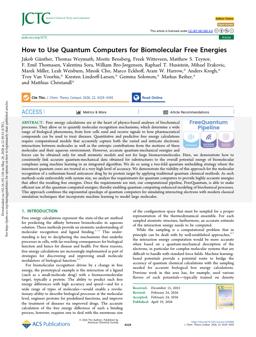
Free energy calculations are at the heart of physics-based analyses of biochemical processes. They allow us to quantify molecular recognition mechanisms, which determine a wide range of biological phenomena, from how cells send and receive signals to how pharmaceutical compounds can be used to treat diseases. Quantitative and predictive free energy calculations require computational models that accurately capture both the varied and intricate electronic interactions between molecules as well as the entropic contributions from the motions of these molecules and their aqueous environment. However, accurate quantum-mechanical energies and forces can be obtained only for small atomistic models and not for large biomacromolecules. Here, we demonstrate how to consistently link accurate quantum-mechanical data obtained for substructures to the overall potential energy of biomolecular complexes using machine learning in an integrated algorithm. We do so using a two-fold quantum embedding strategy where the innermost quantum cores are treated at a very high level of accuracy. We demonstrate the viability of this approach for the molecular recognition of a ruthenium-based anticancer drug by its protein target by applying traditional quantum chemical methods. As such methods scale unfavorably with system size, we analyze the requirements for quantum computers to provide highly accurate energies that affect the resulting free energies. Once the requirements are met, our computational pipeline, FreeQuantum, is able to make efficient use of the quantum-computed energies, thereby enabling quantum computing-enhanced modeling of biochemical processes. This approach combines the exponential speedups of quantum computers for simulating interacting electrons with modern classical simulation techniques that incorporate machine learning to model large molecules.
| Additional Metadata | |
|---|---|
| doi.org/10.1021/acs.jctc.5c02088 | |
| Journal of Chemical Theory and Computation | |
| creativecommons.org/licenses/by-nc-nd/4.0/ | |
|
Günther, J., Weymuth, T., Bensberg, M., Witteveen, F., Teynor, M. S., Thomasen, F. E., Sora, V., Bro-Jørgensen, W., Husistein, R. T., Erakovic, M., Miller, M., Weisburn, L., Cho, M., Eckhoff, M., Harrow, A. W., Krogh, A., Van Voorhis, T., Lindorff-Larsen, K., Solomon, G., … Christandl, M. (2026). How to use quantum computers for biomolecular free energies. Journal of Chemical Theory and Computation, 22(9), 4329–4345.https://doi.org/10.1021/acs.jctc.5c02088 |
|