2025-04-25
Physiological responses to affective virtual coach design in a VR fear of heights consultation
Publication
Publication
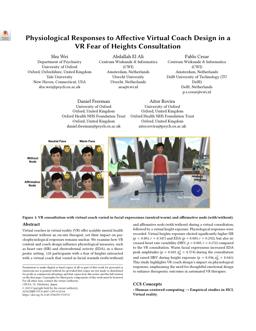
Virtual coaches in virtual reality (VR) offer scalable mental health treatment without an on-site therapist, yet their impact on psychophysiological responses remains unclear. We examine how VR content and coach design influence physiological measures, such as heart rate (HR) and electrodermal activity (EDA), in a therapeutic setting. 120 participants with a fear of heights interacted with a virtual coach that varied in facial warmth (with/without) and affirmative nods (with/without) during a virtual consultation, followed by a virtual height exposure. Physiological responses were recorded. Virtual heights exposure elicited significantly higher HR (p < 0.001, r = 0.347) and EDA (p = 0.003, r = 0.292), but also increased heart rate variability (HRV, p = 0.005, r = 0.272) compared to the VR consultation. Warm facial expressions increased EDA peak amplitudes ($p = 0.043, \eta _p^2 = 0.574$) during the consultation and raised HRV during height exposure ($p = 0.036, \eta _p^2 = 0.041$). This study highlights VR coach design’s impact on physiological responses, emphasising the need for thoughtful emotional design to enhance therapeutic outcomes in automated VR therapies.
| Additional Metadata | |
|---|---|
| , , , , , | |
| doi.org/10.1145/3706599.3719715 | |
| CHI EA '25: Extended Abstracts of the CHI Conference on Human Factors in Computing Systems | |
| Organisation | Distributed and Interactive Systems |
|
Wei, S., El Ali, A., César Garcia, P. S., Freeman, D.& Rovira, A. (2025). Physiological responses to affective virtual coach design in a VR fear of heights consultation. CHI EA: Extended Abstracts of the CHI Conference on Human Factors in Computing Systems, 435:1–435:8.https://doi.org/10.1145/3706599.3719715 |
|