2025-11-07
Advancing learned algorithms for 2D X-ray computed tomography
Publication
Publication
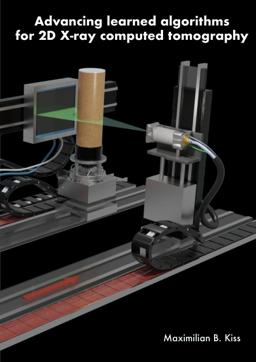
This thesis surveys the intersection of computed tomography (CT) and machine learning (ML), treating CT as an ill-posed inverse problem shaped by object properties, imaging physics, and data limitations. It begins with a foundational overview of CT and the mathematical characterization of tomographic reconstruction, highlighting the need for robust regularization and data-driven strategies. Chapter 2 focuses on tailoring CT acquisitions to the scanned objects, demonstrated by the FleX-ray Lab. It covers scanner functionalities, extension hardware (e.g., sample stages, beam filtration), and acquisition guidelines designed to optimize image quality while managing dose and artifacts. Chapter 3 applies these concepts to multi-material cultural heritage objects, illustrating their impact on image reconstruction and subsequent analysis. Chapter 4 introduces 2DeteCT, a 2D fan-beam CT dataset for developing ML-based reconstruction methods. It details data acquisition, preprocessing, validation, and release, and provides guidance for usage and future extension. Chapter 5 investigates whether training denoising models on simulated noisy data suffices or if experimental noisy data are necessary. Using 2DeteCT and its paired low- and high-dose acquisitions, it scrutinizes the common assumption that simulated noise is adequate for ML training. Chapter 6 presents a benchmarking framework for ML algorithms across CT reconstruction tasks. It offers a reproducible pipeline with standard performance metrics to evaluate full-data, limited- and sparse-angle, low-dose, and beam-hardening–corrected reconstructions, enabling clear comparisons and practical guidance for computational imaging researchers.
| Additional Metadata | |
|---|---|
| K.J. Batenburg (Joost) , T. van Leeuwen (Tristan) | |
| F. Lucka (Felix) | |
| Universiteit Leiden | |
| doi.org/10.60602/1887/4282439 | |
| Organisation | Computational Imaging |
|
Kiss, M. (2025). Advancing learned algorithms for 2D X-ray computed tomography.https://doi.org/10.60602/1887/4282439 |
|